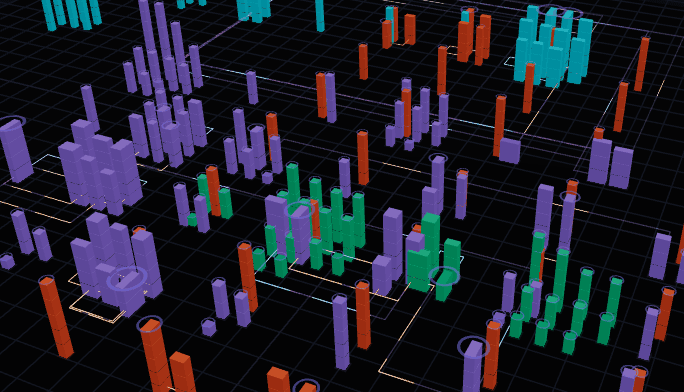
Code towers
Packages stack by size and coupling — see architectural weight at a glance.

Code intelligence
CodeCityScape builds a full module dependency graph from real imports — not guesses — and renders it as a live 3D city. Change frequency, test coverage, architecture health, and CVE exposure are all layered on the same map, updated on every commit.
Free tier available · No credit card required
Live preview · procedural city · commit replay
Inside the product
The three views your team will live in — from macro architecture down to per-file coverage.
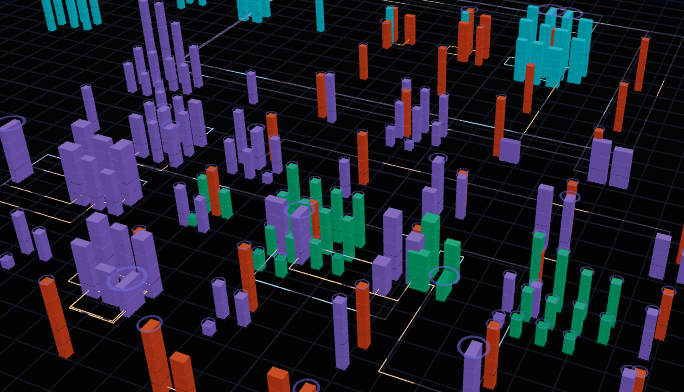
Packages stack by size and coupling — see architectural weight at a glance.
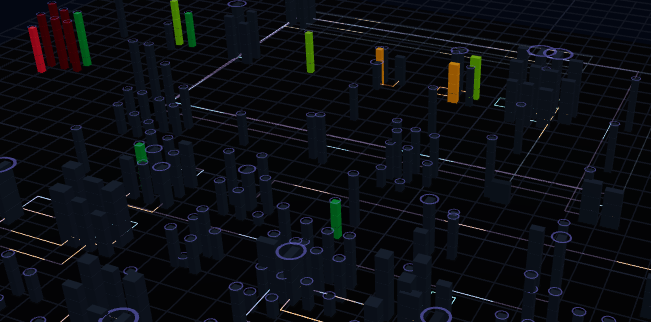
File-level coverage overlay to find untested critical paths (Team+).
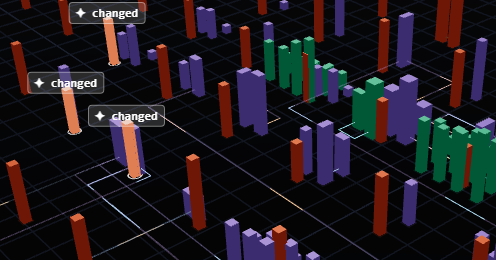
How the graph evolved with commits and releases over time.
How your team uses it
CodeCityScape surfaces in the places your team already works — PR comments, alert emails, and the scene you open when something goes wrong.
Every PR triggers a status check posted automatically to GitHub: health delta, new circular dependencies, and coverage change. Click through to watch the change ripple across the dependency graph before a single reviewer approves it.
The city re-indexes on every merge. No stale diagrams, no missing services. Circular dependencies glow red — found by Tarjan's algorithm, exact modules listed. Layer violations are scored 0–100 with the sprint they first appeared.
Test coverage is painted as floors on every tower. A module at 23% isn't a statistic — it's a visually empty building sitting next to the modules that import it. Share the scene with your team via a public snapshot link — no account needed.
One critical CVE lights up 31 modules in red. BFS propagation shows exactly which teams own affected paths. The exposure is a map, not a list — the "Dismiss" button stops getting clicked.
Built for every role
The city is the shared surface. What each person sees on it — and what they do next — depends on the role.
Lead developer / tech lead
Instant architecture truth. No more "what does this actually depend on" archaeology — the graph is live and you didn't have to draw it.
Engineering manager
A health score you can show in a board review without building slides. Point at the city and say "this district is the problem" — everyone in the room gets it.
PR reviewer
Impact depth in the PR comment. The check tells you what changed and how far it propagates before you read a single line of diff.
New joiner
An actual map of the codebase on day one. Explore the city, click towers, and understand ownership before you touch a file.
Security / platform team
CVE propagation depth shown visually — only the modules your team owns that are actually affected. Not a filtered list; a spatial picture.
QA manager
Coverage gaps shown spatially against the modules that changed. When a PR touches a low-coverage path or a dependency shifts, you see the exposure before testing begins — not after a defect escapes.
How it works
No agents to install, no scripts to run. Point CodeCityScape at your repo and keep working.
Authorize a repo — public or private — in seconds. We never store your source.
Parsers extract modules, dependencies, and change history across 11+ languages.
Fly through your repo, replay commits, and overlay coverage to spot risk fast.
Review the changes, enabling informed decisions to be made.
Languages
First-class parsing and dependency edges for the stacks below. We expand coverage regularly — if you need another language or dialect for your org, tell us.
Need Swift, PHP, or something else? Request a language — we prioritize by customer demand.
Connect a repository in under a minute. Free tier available.